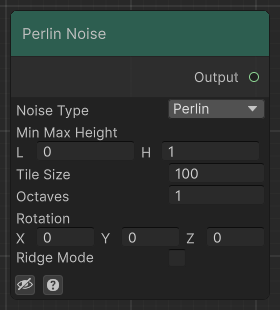
Generates a texture following the pattern defined by the Noise Type.
- Noise Type: The pattern to generate. See Noise Types
- Min Max Height: The minimum and maximum value of height that the pattern will take. It is recommended to consider the units to be the same as your scene. Ex: A maximum of 2 should represent a maximum height of 2 meters.
- Tile Size: The size of a pattern. A big size will spread out the features of the noise making them less recognizable but a smoother terrain, while a small size will create more prominent features.

Scale of 40

Scale of 100

Scale of 300
- Octaves: Represent how many frequencies are going to be used for the generation of noise. More octaves means more low-level detail but slightly more expensive. It is recommended to keep the value of octaves between 1 and 10.

1 Octave

2 Octaves

8 Octaves
- Rotation: A rotation matrix that gets applied to the noise.
- Lacunarity: Enabled if there is more than 1 octave. Defines how each frequency is scaled for the subsequent passes. Normally the value should stay around 2 to 10.

2 Octaves, 2 Lacunarity

2 Octaves, 8 Lacunarity
- Persistence: Enabled if there is more than 1 octave. Defines how much is the amplitude reduced between octaves.

2 Octaves, 2 Lacunarity, 0 Persistence

2 Octaves, 2 Lacunarity, 1 Persistence
- Ridge Mode: Folds the noise values through the middle to create a ridge like effect.
Noise Types
Currently available patterns to generate using the Noise Node

Perlin

Perlin Value